Artificial intelligence is becoming an increasingly common part of education, but not every AI platform is designed specifically for the classroom. Teachers need tools that can support learning without simply replacing the teaching process, while students need an environment that encourages participation, practice, and exploration. SchoolAI is built around this idea, offering an AI-powered platform designed specifically for educators and students.
Rather than functioning as a general-purpose chatbot, SchoolAI focuses on educational use cases. Teachers can create and use AI-powered learning experiences, monitor student interactions, and provide students with guided opportunities to work with AI.
This SchoolAI review looks at the platform’s main features, classroom applications, user experience, teacher controls, student learning environment, pricing considerations, and the type of educator or institution that may find it useful.
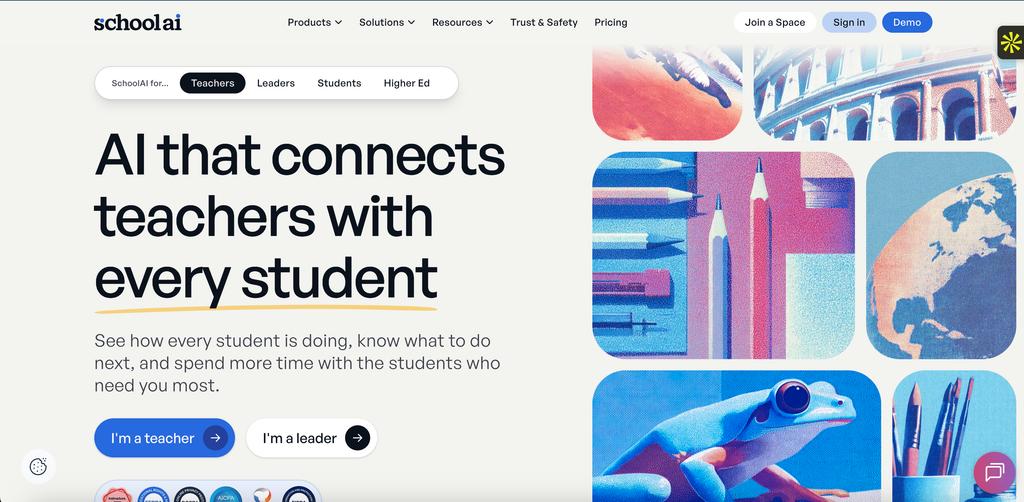
About SchoolAI
SchoolAI is an education-focused artificial intelligence platform created for teachers, schools, and students. Its goal is to make AI more practical and manageable within educational environments.
The platform provides teachers with tools for creating AI-powered learning experiences and allows students to interact with AI in ways that can be connected to classroom objectives.
This distinction is important. A general AI chatbot can answer questions across almost any topic, but it may not provide the classroom-specific controls and structure that teachers need. SchoolAI approaches AI from an education-first perspective.
The platform can be used across different subjects and grade levels, depending on how teachers structure their learning activities.
What Makes SchoolAI Different?
One of SchoolAI’s main differentiators is its focus on teacher-guided AI rather than unrestricted chatbot use.
Teachers can create learning experiences designed around particular topics, assignments, or classroom goals. This can give students a more structured way to interact with AI.
The platform also emphasizes visibility for educators. Instead of having students independently use an external AI tool with little classroom context, SchoolAI provides teachers with tools intended to help them understand and manage student interactions.
This can be particularly useful as schools develop policies around responsible AI use.
AI Spaces and Learning Experiences
A major component of SchoolAI is its use of AI-powered learning experiences, often referred to as Spaces.
These experiences can be designed around specific educational activities. A teacher might create an AI interaction that helps students practice a language, explore a historical topic, work through a science concept, or receive guided assistance with an assignment.
The advantage of this approach is that the teacher can determine the context in which AI is being used.
Instead of simply telling students to “ask AI about this topic,” an educator can build an activity with a defined purpose and learning objective.
This can make AI more useful as a teaching aid rather than simply an answer-generation tool.
Teacher Tools
SchoolAI is designed to give educators a central role in the AI experience.
Teachers can use the platform to create activities, share learning experiences with students, and monitor classroom engagement.
For educators, this can reduce some of the difficulty involved in introducing AI into lessons. Rather than expecting teachers to develop complicated AI workflows themselves, the platform provides an education-oriented environment.
The usefulness of these tools depends on how teachers incorporate them into their existing teaching methods. AI works best when it complements instruction rather than becoming the only source of explanation or assessment.
Student Experience
From the student’s perspective, SchoolAI can provide an interactive way to explore educational topics.
Students can interact with AI through teacher-created experiences, allowing them to ask questions, practice concepts, and receive responses within a defined learning context.
This can make learning more conversational than traditional worksheets or static online resources.
The approach may be particularly useful for students who benefit from additional practice or prefer interactive learning. At the same time, teachers still need to encourage students to evaluate AI-generated information rather than accepting every response automatically.
Developing that critical-thinking habit is an important part of responsible AI literacy.
Classroom Applications
SchoolAI can potentially be used across a wide range of classroom activities.
Language Learning
Teachers can create conversational activities that allow students to practice vocabulary, grammar, writing, or communication.
An AI-based conversation can give students opportunities to practice repeatedly without requiring the teacher to conduct every individual interaction.
History and Social Studies
AI learning experiences can be designed around historical events, figures, or different perspectives.
Students can use guided conversations to explore a topic and ask follow-up questions.
Teachers can then use the interaction as part of a larger lesson rather than treating AI as a replacement for source material.
Science
SchoolAI can help create interactive explanations and practice activities around scientific concepts.
Students can ask questions and work through concepts conversationally, potentially making difficult topics easier to explore.
Mathematics
AI can also be used to provide guided practice and explanations.
Rather than simply displaying an answer, a well-designed learning experience can encourage students to work through a problem step by step.
Writing
Writing is another area where AI can provide useful support.
Teachers can create activities that help students brainstorm, revise, analyze writing, or practice specific skills. Used carefully, this can help students understand the writing process rather than simply generating finished assignments for them.
AI Safety and Classroom Control
One of the biggest concerns surrounding AI in education is how students interact with unrestricted AI systems.
SchoolAI’s education-specific design attempts to address some of these concerns by placing teachers and classroom activities at the center of the experience.
Teacher visibility and structured AI interactions can make it easier for educators to introduce AI while maintaining an educational purpose.
However, no AI system eliminates the need for supervision. Teachers and schools should still establish clear rules around acceptable AI use, academic integrity, personal information, and verification of AI-generated content.
Ease of Use
For a platform aimed at educators, ease of use is particularly important.
Teachers generally do not have the time to build complicated technical systems just to introduce an AI activity into a lesson. SchoolAI’s focus on ready-to-use and customizable educational experiences is intended to make adoption more accessible.
The learning curve will still vary depending on how deeply a teacher wants to customize activities.
Teachers who are already comfortable with digital tools and AI may be able to explore more advanced possibilities, while beginners may prefer starting with simpler classroom activities.
SchoolAI for Teachers
For individual teachers, SchoolAI can function as an additional resource for lesson planning and classroom engagement.
It can be used to introduce interactive activities without requiring teachers to develop their own AI system.
Another potential advantage is experimentation. Teachers can explore different ways of using AI and determine which activities actually improve classroom engagement.
The platform is therefore not necessarily something that has to replace existing teaching resources. It can instead be incorporated into selected lessons where interactive AI adds value.
SchoolAI for Schools
Schools considering broader AI adoption may find the platform particularly relevant because it is designed around educational environments.
School-wide AI adoption requires more than simply giving students access to a chatbot. Administrators also need to consider student safety, teacher oversight, privacy, academic integrity, and responsible use.
A platform built specifically for education can provide a more structured starting point for these conversations.
Schools should nevertheless review the platform’s current privacy documentation, data practices, administrative controls, and terms before implementing it across an institution.
Website Experience
SchoolAI’s website presents the platform primarily as an education technology service rather than a general AI product.
The information is organized around educators, students, classroom applications, and AI-powered learning experiences.
For teachers researching AI tools, this education-specific positioning makes it relatively straightforward to understand the platform’s intended purpose.
As with any software service, features and interface details can evolve, so users should check the current website for the latest functionality.
Pricing and Overall Value
The value of SchoolAI depends largely on who is using it and how extensively it is integrated into teaching.
For an individual teacher, the availability of useful classroom tools can be valuable if they save preparation time or create learning experiences that would otherwise be difficult to build.
For schools and districts, the calculation is broader. Administrators may need to consider the number of educators and students, available features, administrative requirements, and any institutional pricing arrangements.
Before adopting the platform, schools should review the current pricing and plan details directly because software features and subscription structures can change.
Who Should Consider SchoolAI?
SchoolAI may be relevant for:
- Teachers experimenting with AI in the classroom
- Schools developing AI literacy programs
- Educators creating interactive learning activities
- Teachers looking for guided AI experiences
- Schools interested in structured student-AI interaction
- Educators teaching students how to use AI responsibly
It may be less necessary for educators who rarely use digital tools or who already have a classroom system that provides all the AI functionality they need.
Is SchoolAI Worth Using?
SchoolAI’s value comes from its education-specific approach to artificial intelligence.
Instead of treating AI simply as a general chatbot, the platform gives teachers a framework for incorporating AI into lessons and creating structured student experiences.
For educators who want to experiment with AI while keeping learning objectives and teacher involvement central, this can be useful.
The most important factor is implementation. AI should support teaching, discussion, practice, and critical thinking rather than becoming a shortcut for completing assignments.
Schools should also evaluate privacy, safety, accessibility, and institutional requirements before introducing any AI platform to students.
Final Verdict
SchoolAI offers an education-focused approach to artificial intelligence, giving teachers tools to create interactive learning experiences and giving students opportunities to engage with AI in a more structured classroom environment.
Its emphasis on teacher involvement distinguishes it from simply giving students unrestricted access to a general-purpose AI chatbot. The platform can be used across subjects, from language and writing to mathematics, science, and social studies.
For teachers and schools exploring practical applications of AI in education, SchoolAI is a platform worth examining. Its effectiveness ultimately depends on how thoughtfully educators integrate its tools into lessons and how clearly schools establish expectations around responsible AI use.